Sunday, February 16, 2014

Belated Valentine's Day Thoughts


One nice thing about not having a "squeeze" in my life is not having to worry about falling short on Valentine's day.  I remember, one year, hustling down to the flower shop at the last possible minute before heading over to Nicole's place for a romantic dinner.  "A dozen red roses, please, if you've got any left", I said to the smiling flower clerk.  "Why yes of course we've still got some.  Most of our business comes on Valentine's day afternoon.  We stock up on red roses just for forgetful guys like you who are kind of over a barrel because of last minute purchases.  That'll be $ 125." she announced cheerily with a glint of smugness.  " $ 125 ?---wow.  That's a hell of a lot for twelve flowers!"  I replied.

       Now I imagine running a small flower shop in downtown Mill Valley must be a challenge.  Because of the desirability of these store fronts in the heart of our quaint and precious little village, the rents must be sky-high.  You can tell by how quickly these little ventures come and go that these poor shopkeepers struggle daily to maintain a positive cash flow and I imagine that profit margins are razor thin.  Having an MBA in finance and accounting, and having once been a partner in a recording studio, I knew something about struggling businesses.  "Okay", I sighed.  "I'll take them.  Just one question; how much will these same flowers cost tomorrow?"  She smiled, "Oh probably about $ 30-35.  The mark-up on Valentine's day gets us through to Easter.  Come a little earlier for Easter, the Cala lilies will probably triple in price come Easter morning.  We'll be open to 1 PM on Easter."

As I mentioned, now that I'm post-sexual, I don't have to deal with being in a romantic relationship and the obligatory flower purchase.  This year, I sent my platonic lady friends talking Valentine e-cards with silly messages.  I imagine they were surprised to hear from me at all.

The cherry-plum trees in the back yard and the plum tree in the garden are all in glorious blossom.  That's a risky strategy for these trees.  But because of our balmy, droughty weather for most of this year, they couldn't help themselves.  The problem is, it's not quite warm enough for our little denizens in the apiary to be out and about pollinating.  They have their sugar water to sustain them till Spring.  With the cherry and plum blossoms unpollinated, there's a risk that a heavy rain at this point will knock all the blossoms off and there won't be any fruit this Summer.  It has happened several times before and it's very disappointing to have no plums in June and July or pears in August.  Keith, my eighty-two year old British beekeeper--he was reading law at Cambridge in '52, within whose bosom hope springs eternal, has planted a cherry tree and another peach tree down in the apiary.  After helping him to plant them a few weeks ago, I haven't been down to see how they're doing.  I think I'll do that today as it appears that it's going to be a lovely, sunny day.  I noticed that the peach tree we planted was already budding.

When I decided that my garden needed some fruit trees back in '91, I consulted my almanac; Organic Gardening Magazine.  The editor, a third generation organic gardener and grandson of the original editor, had recommendations for the types of fruit trees to plant.  I trusted his choices, as he was "standing on the shoulders of giants".  His grandfather J.I. Rodale had been a huge promoter of all things organic and had been urging people to grow their own since 1940 when he started his own "Experimental Organic Farm and Garden".  At Mr. Rodale's urging, I planted heirloom trees on M-1 dwarf root stock.  Even at maturity the trees will be short enough that you'll never need more than a small wooden step ladder or a long handled fruit picker to harvest (I have both---the fruit picker, though, is tricky; especially when you have a cluster of fruit.  And harvesting before the damn yellow jackets get after them is also a bit of a challenge).  J. I. Rodale, along with people like the Englishman Alan Chadwick, was one of the pioneers of organic gardening in this country.  After he turned the editor's job over to his son, he traveled all over the world, lecturing on the importance of growing organically.  He was killed in a car crash on an icy road outside of Moscow after a lecture in 1971.  R.I.P.  

You plant fruit trees in the middle of Winter when growth is dormant.  So in mid-february, I journeyed to several specialty orchard tree nurseries to buy what they call "bare root whips".  These are fruit trees that are just a year old and their roots are covered in damp wood shavings.  They look just like buggy whips and it takes a leap of faith to plant them.  The orchard owners assured me that if I did the planting, as instructed, they would grow and probably bloom the following Spring.  With their trimmed root balls carefully trussed up in wet burlap bags, I laid them in the bed of my pick-up truck and drove down through the horse pasture to the garden.  I dug six holes for my infant dwarf heirloom fruit trees while a heavy rain poured down.  I had to dig the holes fairly large and deep to accommodate wire gopher baskets.  The resident dog, a young and very spirited golden lab, had a serious jones for retrieving thrown objects.  The rain didn't dampen her spirits one iota so the planting "drill" went something like this:  Stevie would drop the tennis ball next to the hole I was digging.  If I didn't respond immediately, she would push the ball with her nose till it fell into the hole.  At this point I would get down on my knees, fish the damn ball, covered in mud and dog slobber, out of the hole, and heave it out of the garden and down the hill as far as I could.  

     Now I had been a baseball pitcher in my youth and I still had a pretty good arm.  The ball would sail up and over the greenhouse roof and bounce down the slope above Highway One.  With the ball and the dog a good hundred yards away by now, I would hurriedly continue digging.  I usually got about three or four spadefuls dug before dog and ball magically reappeared 'hole-side'---damn that dog was fast---in moments, the ball was back in the hole and Stevie Wonder-Dog would look up at me with a quizzical look as if to say, "C'mon, guy!  What's the hold up?"    

I eventually got the trees planted, aided by several mighty heaves of the tennis ball that had Stevie running down the side of the road to retrieve her prize.  Now we get to enjoy Spitzenberg and Spigold German heirloom apples; Doyenne' fancy French  desert pears; Fuji golden russeted Japanese desert pears, (often called apple pears because of their crunchiness.  I especially like them poached in pernod + sugar syrup); Santa Rosa plums and nectarines from a tree I bought at a nursery in Bolinas.  The nectarine, alas, never really panned out.  Although the fruits had a wonderful perfumey aroma, they never got much bigger than duck eggs and now, twenty-three years later, the poor tree appears to  have end-stage cancer...  All we can do now is give it palliative care.  It could probably use a morphine drip at this stage of its life.

Valentine roses and heirloom fruit trees; how the hell did they get mashed together?  I blame my fingers.  Once I let them out of the box in the morning and they are hovering over the keyboard, I never know what the hell they're going to type.  And for that, dear reader, I apologize.  

Mickey da Mayor of Happy Acres

Here's our new cherry tree in early blossom.  In the background is the rental cottage I built.  God bless Mill Valley rental prices.

Here's our new peach tree being guarded by one of our bee hives.  I love the red branches shining in the morning light.  If you look closely, you can see the fruit buds.  Looks like peach cobbler this Summer!  If we can harvest before the yellow jackets do...
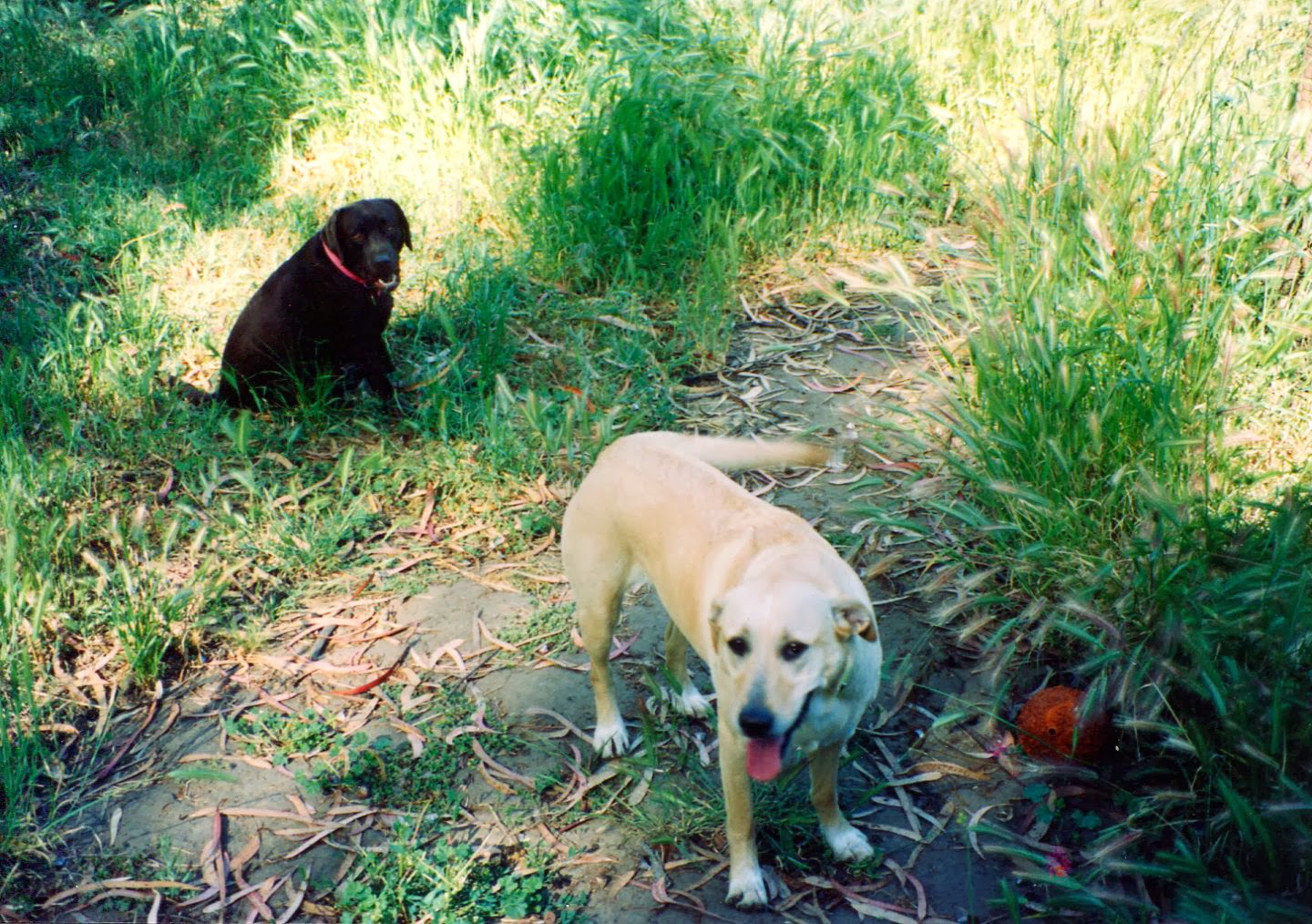
That's Stevie Wonder Dog in the foreground waiting for me to put away the damn camera and throw her orange fluffy again---and again---ad nauseam.  In the background we have her partner in crime, Jester the Molester (he's uncut...).  Jester's owner, (not me), took him out mountain biking when he was a pup.  That permanently weakened his leg tendons and he eased his distress by sitting down a lot.  He used to follow me around the horse pasture while I shoveled up horse manure for the compost pile.  He would sit patiently while I did my shoveling.  Sometimes the horses would come over to investigate.  They were intrigued by this immobile brown creature sitting next to my garden cart.  Sometimes they would bend over Jester and give him a sniff and a gentle nudge and occasionally a little nip on his lustrous brown coat; at which point The Molester would look up at me with his sad but loving brown eyes as if to say:  "You've got my back on this, right?"  Jester made it to David Letterman's show where he was featured on "Stupid Pet Tricks".  Because of his tendinitis, it was painful for Jester to walk down stairs.  Instead, he would get down on his belly and pull himself down with his forelimbs, softly grunting as he went.  We called it "Downward Dog".  It wasn't till many years later that I learned that the term actually referred to something yoga sufferers did...

A rare moment of repose between bouts of ball retrieval.  Alas, neither Stevie nor her owner are with us anymore.

I believe this precious moment came right after Jester The Molester asked Stevie Wonder-Dog to be his valentine.  No, we did not pose the dogs.  Happy belated Valentine's Day!

Tuesday, February 11, 2014

When the Bough Breaks


     Yesterday at "the club" I ran into an old neighbor of mine here at Happy Acres and we had an extended chat about the old days in our neighborhood.  He and his wife lived right across the street in the little two bedroom bungalow that I had briefly lived in with the gal I moved to Happy Acres with.  The year was about '80 or '81 and they had just moved in.  Our little recording studio in the old garage was directly across the street from their house.  In those days the studio was busy day and night.  When I went up to meet my new neighbor I said;  "Hi, neighbor.  My name is Mike"  I stuck out my hand and we had a very perfunctory handshake.  Instead of introducing himself to me, the first words out of his mouth were:  "Does that guy have to play so loud?"  This was the first of many skirmishes we would have about the studio.  I learned from former neighbors down in lower Tam valley that this couple had made themselves person non grata there and they were glad to see them go.


The husband was ultimately successful in getting "that guy to stop playing so loud"; or any of our other studio musicians.  Many's the time when there would be an evening session going on, and the sheriffs would show up with a complaint from the guy across the street.  He once called up my landlord at three in the morning and yelled at him:  "Hey Quadros!  If I can't sleep, you're not gonna sleep either!"  That little stunt actually put the landlord in our corner as we could all agree;  this guy was a jerk.  What we were doing, I'll concede, was against zoning regulations.  You can't have a commercial recording studio in an R-1 zoned neighborhood.  He called the county and issued a formal complaint and eventually, we all had to attend a meeting of the Marin County Board of Supervisors where we were summarily given our walking papers.  We had three months to disband our funky little studio and its merry band of music-makers.  The couple across the street had won.  During all this time, the husband and I carried on a personal feud where we studiously ignored each other, which was a shame.  In other circumstances I'm sure we could have been friends.  He was at Cal in the late sixties and I was at Stanford at the same time.

The wife could be a nuisance too.  She had got it into her head that one of the limbs from one of our Eucalyptus trees was hanging over their property like the sword of Damocles.  The couple had recently put in a new fence and planted rose bushes under the offending tree limb and the wife was adamant that that "Sword of Damocles" be safely cut down.  They kept harassing my poor, put-upon, landlord till we finally agreed to accede to her wishes.  I knew a guy who had a side business trimming trees so we hired him to climb up the eighty feet or so it took to get to the limb.  He shinnied out to the end of the "limb-of-death" and affixed a long rope to it.  Five of us grabbed the other end and retreated to the driveway next to our house which was perpendicular to where the rose bushes were.  If the limb, when cut, came toward us, all would be saved.  (and we would all live happily ever after...).

      We could hear Rich, the tree man, hollering that he felt really, really uncomfortable up there and that the wind was picking up.  (I think Rich did most of his tree pruning off a ladder...)  By this time he was at the base of the death-limb and he fired up his chain saw and commenced to cut.  As the limb began to sag (we could hear it groaning and cracking---it really was a big limb.  These huge Eucalyptus branches were heavy and weak and were known as "widow makers..."),  Rich cried out:  "OK YOU GUYS, START PULLING ON THAT ROPE!"  At Rich's command, we started doing our best "yo-heave-ho".  Suddenly with a mighty CRACK! the limb was sheared from the tree and started to fall.  Unfortunately our rope-pulling efforts had no effect on the limbs downward trajectory and it came down with a resounding crash;  wiping out the couple's new fence and rose bushes.  I turned to the rest of the "fellas", who were quietly snickering into their hands (no one liked these guys...), and said:  "Be careful what you wish for, you just might get it!"
There were other misadventures with the neighbors from hell.  Perhaps another time.  I remain, ever at your service, Mickey da Mayor of Happy Acres (TIMBER!!!)


ABOVE AND BELOW ARE TWO VIEWS OF A EUCALYPTUS BRANCH THAT FELL WHERE I USED TO FEED THE FOUR HORSES I BOARDED AT HAPPY ACRES.  AN INSURANCE INSPECTOR SAID THAT THE PROPERTY'S LIABILITY INSURANCE DIDN'T COVER INJURY TO HORSES NOT OWNED BY MEMBERS OF THE HOUSEHOLD AND I HAD TO ASK THE HORSES' OWNERS TO BOARD THEM ELSEWHERE.  I GUESS THE INSURANCE GUY KNEW WHAT HE WAS TALKING ABOUT!


     Please note the fallen limb in the background.  It's about the size of the death-limb that fell on the rose bushes.  This one fell in 2001.  It measured from stem to stern at about 100 feet...
This is actually a different limb than the one in the upper two pictures.  And they say that lightening never strikes twice in the same place.  Tell it to my Eucalyptus trees!

Monday, February 10, 2014

Sand and Sage Brush: Part 2


     I had a few days to kill in Wells before my partner, Terry Fotre, showed up in his sports car.  I knew that Nevada, in certain counties, allowed prostitution.  I found out that we were in such a county and there were two whore houses out by the railroad tracks.  I remember that one was called the Hacienda; I don't remember the name of the other one.  So the day after my motel room frolic and accusations of white slavery (see part one, below), I decided to check out this house of ill repute for myself.

     This cat house, "The Hacienda", was, literally, on the other side of the tracks.  I was a little intimidated at visiting this house what with all the baggage that the word "whore" has attached to it.  I had never, knowingly, met such a person and I wanted to see for myself.  I walked through the swinging saloon doors and entered the bar.  It was a fairly large room with a high ceiling.  The walls were covered in a red velvet patterned wall paper.  Very red.  Hanging on all the walls, and behind the bar were large paintings of voluptuous women in various states of recline and undress.  The painter Paul Rubens comes to mind...


I think you get the picture.  I ordered a drink and sat at the bar.  As my eyes got accustomed to the low light inside---it was hot and bright outside---I noticed that there were several women lounging at a corner table.  They were looking at me and smiling.  They were wearing a bit more clothing than the women in the pictures above, but not by much.  Their sheer tops revealed that these gals had forgot to put on their bras that morning.  I was of equal parts fear and arousal.  The two ladies whispered briefly to each other 
then one of them came over and sat down next to me.  "Buy me a drink, big fella?" she murmured in a whispery voice.  "Why, uh, of course!  Uh, what would you like?"  I stammered, like the college boy that I was.  My experience with women was fairly limited as I had only lost my virginity earlier that year.  I believe the situation called for flirtation on my part.  I quietly cleared my throat and started to chat with "Kitty"---I doubt if that was her real name.  I wasn't that naive.  I don't remember the specifics of the conversation.  I paid for our drinks and decided not to purchase anything else.

     The next day Terry arrived.  I threw my duffel bag in the trunk of his sporty little Triumph TR 4-A convertable and we headed out to our home for the Summer.  Montello, as I mentioned in part one of this "saga", was thirty-five miles up the road from Highway 80 on a small two lane that eventually led to Idaho.  As we drove East then North, we remarked at how desolate the landscape was.  As the inn keeper had told me the night before; nothing but sand and sage brush (and the occasional rattlesnake).  In the distance, shimmering like a mirage, we could see a lonely little outpost of humanity.  Welcome to Montello.  The "town", if you can call it that, consisted of about fifteen houses, a motel, a grocery store/ cafe and across the tracks from the road there was a little train station.  The station  looked just like the ones in the old cowboy movies.  This town, basically supported the railroad repair depot that was adjacent to the train station.  As we learned from the motel owner/manager, itinerant, nomadic railway workers were assigned to this depot and they stayed in the motel rooms.  They were responsible for track and railcar maintenance in the greater vicinity.  The following pictures are representative of the working life of these "gypsy" railroad workers.  In the picture below, you'll notice that two stops before "Wells", is "Death".  Staring down the tracks as they headed to Idaho, and disappeared in the shimmering desert heat, I was reminded of all those sad and lonely folk and cowboy songs about trains.  I think Bob Dylan wrote one wherein he laments that it takes a lot to laugh; it takes a train to cry.  Hear that lonesome whistle blow.  I now know where "lonesome" resides; on an empty train track in an empty desert of sage brush and sand (and the occasional rattle snake...).


     In the sand and gravel courtyard of the motel were parked about six air-stream trailers.  They were beautiful things, all shiny and silver with their rounded edges.  Then there was our trailer.  It was about half the size of the air-streams and had roughly the same shape as the old Volvo hump-backed cars from the 50's.  It had a tiny little kitchen, an even tinier bathroom and a small bed in the back.  In the front was a small dinette table with two chairs, done up in faded chrome and yellow vinyl.  At the front end of the trailer was a sort of bench/couch deal that folded out into a little bed.  Terry and I took turns  with the sleeping arrangements.  The geologists got the air-streams.  One was set up as an office and that's where the cartology took place.  Terry and I tried, but couldn't manage to squeeze into the little shower stall in our trailer, so we showered in the comparative luxury of the office air-stream trailer bathroom.  We were each assigned to a geologist, who would be our boss for the Summer.  When we were introduced to our "masters", I could tell from a rather resigned look on their faces that they all must have drawn straws to see who was going to be working with the "college kids" and our guys drew the short straws.  

     They briefly explained the job to us.  Most of the time we would be bouncing through the sage brush looking for these elusive bench marks, as was mentioned in my prior posting.  The next day we went down to the local grocery store/cafe and bought provisions for our little nano-kitchenette.  Choices, as you can imagine, were limited.  The meat counter had a large bologna loaf.  You would hold two fingers apart and the butcher would hack off a piece of bologna that size.  White bread, a slice of bologna, a hunk of cheddar cheese, mustard, mayonnaise and a bunch of fresh fruit would be our daily sack lunches.  That Summer, almost without exception, we ate our lunch in the truck with our geologist.  After wolfing down our sandwiches, there was time for a cup of coffee and a smoke or we could nap for a few minutes.  

     As I got into the Dodge Power Wagon, an "all wheeled vehicle with unbridled power", I was cautioned by my geologist/boss to buckle up tight.  I soon found out why.  Where we were going, there were no roads.  We were bouncing up and over sage bushes, some as big as a washing machine.  One thing I'll say for these trucks; they sure could take a licking and I was glad they had seatbelts, otherwise I would have been hitting my head on the cab's ceiling.  For water we had a kind of canteen called a swamp cooler.  The sides were made of a thick felt-like material and the water would slowly weep through the fabric.  The evaporation of this weeping water kept the canteen contents relatively cool, compared to the air temperature which was almost always in the mid-nineties.  But, yes folks, it was a dry heat.  It looked like it hadn't rained since Noah's ark put to sea and I marveled that the sage bushes could survive in such a hostile climate.  

     Every now and then, in my futile desert wanderings, searching; every searching, for the elusive little posts called bench marks, I would scare up the odd jack rabbit or coyote and a couple of times, a herd of wild horses.  Once, while we were lunching in our truck I looked up to see a mountain lion perched on a large boulder, eyeing us cooly.  Otherwise it was just sand and sage brush.  I occupied my mind, during these interminable wanderings, by imagining a  folk-rock band I was going to put together when I got back to Stanford for my sophomore year.  Two guitars---I would play a Rickenbocker electric twelve-string---bass, drums and keyboards; maybe an electric piano and a Hammond B-3 organ with Leslie speakers.  My fantasy rock band would be called "Organ Grinder".  When I got back to our little trailer after work in the late afternoon, I would grab my guitar and write songs that I would later arrange for my fellow players in the band.  Back at Stanford that Fall, I eventually got as far as playing a Rickenbacker in a music store in the city but lost my nerve when it came time put my money on the table.  However the fantasy helped to occupy my mind that Summer as I wandered through the sand and sage.

     In the morning when we'd get up and fix breakfast before work, the butter would be as hard as leather and almost impossible to spread on our toasted wonder bread without ripping the toast to shreds.  When we came back after work, the butter would be a "sea of ghee" floating in the butter dish.  For those of you who haven't enjoyed a prolonged stay in the Sonoran desert:  Very hot and dry during the day; very cold and dry at night.

     In the final posting of this trilogy, I'll write about some of the locals we met and some of the weekend trips we took, including the High School Prom in Big Piney, Wyoming, where we put together a band for the big dance, featuring Beaver Cleaver on lead vocals.  If you want to find out how Terry and I spent the weekend with Jerry Mathers aka "The Beave", you'll have to wait for the final installment of this trilogy.  

     Till then, 'pardners', Happy Trails to You, until we meet again...Mickey da Mayor of Happy Acres

Beaver Cleaver in his prime.


Friday, February 7, 2014

Sage Brush and Sand: My Summer, Wandering the Desert: Part One

     As my freshman year at Stanford was winding to a close, I was of two minds at the prospect of returning home to Hawaii.  I was looking forward to immersing myself again in the waves and the warm clear water of Hawaii.  I had been to the local beach, San Gregorio, several times.  The first time I was invited by some dormmates to go to the beach, I put on a bathing suit, a tank top, and some flip-flops.  "No, no, Mike this isn't a swimming beach." chuckled Chip, the trips instigator and driver, "You want to put on a parka, a wool watch cap and some hi-top boots, if you have them."  The beach was cold and foggy and the water, whipped by a frigid on-shore wind and gun-metal grey in color, looked singularly uninviting.  The only life visible in the ocean were little salt water ducks, diving under the waves breaking on the shore.  We built a bonfire to warm up.

     It had been nine long months of no waves breaking in clear blue warm water.  On the other hand I was not looking forward to spending a Summer locking horns, again, with my stepmother.  One of the things I loved at being at "University", was my independence.  Back home, I would just be the problematic teenage son.  It would be a step backward in terms of my growth as a person.  A fellow dormmate who lived at the end of the hall approached me with a proposition for a Summer job.  I hadn't  been very close to Terry that freshman year but I liked him well enough.  He was the kind of jolly, stocky chap with pink cheeks who the girls would refer to as a "teddy bear".

     "I heard that the U.S. Geological Service was looking for rod-men for a project in Nevada.  So I went up to their office in Menlo Park." Terry enthused, "The job sounds really cool.  We'll all be living in trailers in Eastern Nevada and we'll spend our days with the geologists mapping something called the Cobre Project.  It has to do with the old trans-continental railroad.  When the railroad was built back in the mid eighteen hundreds it was granted parcels of land on either side of the tracks in a checkerboard pattern.  Each one was a mile square and the edges were marked with wooden posts called bench marks.  The job is to find those old bench marks.  The USGS needs the exact locations of those bench marks to accurately map the area.  The guy I talked to said it would be a wonderful adventure.  There's hunting and fishing in the Pequop mountains nearby.  Whaddaya you say, Mike.  You wanna do it with me?"

     "Wow, Terry, it does sound like quite an adventure." I replied, "But I don't own a hunting rifle or a fishing pole for that matter.  I mean, if we did manage to get a rifle and say we shot a deer; then what?  Do we skin it and butcher it and bring huge hunks of deer meat back to our little trailer?  I'm sure there are other pursuits we could find to do on the weekends besides hunting.  Are you gonna have a car?"

     "Don't worry, Mike.  In case you hadn't noticed, I've got a sweet little Triumph TR 4-A convertable sports car parked outside." Terry replied pointing out the window.  "I have to go home for a couple of weeks when school's over.  You could take a bus to the town nearest the job sight.  I looked on the map and Wells is right on highway 80 and it's only a few miles up a little side road to the town where we all park our trailers.  I'll drive up from LA and meet you in Wells, then we drive together to Montello a few miles north of the highway.  Whadda ya say?  You wanna do it?  Let's do it man!  It'll be great!"

     Terry's infectious enthusiasm won me over and I accepted.  He drove me up to the USGS headquarters and I met the job recruiter.  I filled out the application to be a rod-man, GS-3, for $ 2.50 an hour.  The little humpbacked trailer we had passed on the way in was to be our home for the Summer and it was provided for us, free of charge.  He explained what a rod-man did.  "Basically, you will be paired up with one of our geologists who will be on site in their own trailers.  You will be spending most of your time walking through the sage brush of the lovely Northern Sonoran Desert.  Every day your geologist will have to survey.  He sets up his surveying instrument, called an allidade and you hold up the surveying rod and he sights it through the allidade and marks the distance in his little surveying book.  There will be other exciting jobs to do, too; like taking helicopters to the tops of the local mountain peaks so the geologists can take readings with their surveying equipment.  By the end of the summer you'll be tan and fit from all that hiking and you'll have saved a bundle of cash to take back to Stanford and you will have learned all about the fascinating world of map making.  Next year back at school, when you're at some frat party and you hear some guy trying to impress a girl talking about his "book knowledge" of Cartesian Coordinates, you can jump right in and blow him out of the water with how you spent the Summer mapping the Cartesian Coordinates for the Cobre Project in eastern Nevada."

     So it came to pass that I found myself riding a Greyhound bus to a little town in eastern Nevada called Wells.  This all happened forty-five years ago and I don't remember how long I was on that bus.  But I do remember that it was an overnight trip and we made several stops along the way for meals.  I had never been on such a long road trip in my life.    As we journeyed eastward, away from the gambling casinos of Reno the surrounding area quickly became less populated except for these little towns hugging the highway, like baby rats, sucking on the teat of commerce provided by the passing trucks, trains and cars.  It was lonely feeling, being by myself in this strange barren land.  By the time I got off at Wells I thought to myself that this must be the midwest, I had travelled so far East.  Coming from Hawaii where you couldn't drive for an hour without plunging into the ocean, after this marathon bus ride, it seemed like I was at least a third of the way across the country.  As an island boy, my knowledge of U.S. geography was still a little sketchy.

     I found a little motel with a coffee shop and checked in.  Terry would be along in a couple of days to drive us up the road to Montello and our little group of USGS trailers.  I asked the proprietor of the motel how far away Montello was.  "Well, son, you go another twenty-five miles or so East on 80; take a left at Oasis and drive another thirty-five miles or so up 233, a little two-lane road that goes north-east through northeastern Nevada.  If you kept going, it would take you through the northwest corner of Utah and eventually you cross the southern border of Idaho.  You're in the northern end of the Great Sonoran Desert; it extends clear down into northern Mexico.  I sure hope you and your partner like the smell of sage brush, cuz that's all your going to see for next three months; sage brush and sand and the occasional jack rabbit; oh, and keep an eye out for rattle snakes; lots of them around heres too."

     Sage brush, snakes and sand; what the hell had I gotten myself into?  Already I was feeling homesick for my home on the beach in Hawaii.  "I've made my bed and I've got to lie in it", I sighed to myself.  I took a seat at the counter in the mostly empty coffee shop and ordered dinner.  "I'll have the flank steak dinner and a Coors beer." I told the waitress.  One redeeming fact about my new home; legal drinking age, back then, was eighteen.  As I sipped my beer I looked around at the patrons.  The men were done up in basic cowboy motif; faded jeans, shirts with pearl snaps and cowboy boots.  A couple of seats down I noticed a thin young blond girl drinking a coke out of a straw.  She looked over and gave me an encouraging smile.  She gave me a little wave, inviting me to scoot over next to her.

     "Hi!  I can tell you're not from around here, are you?" she said.  "No ma'm, I'm from Hawaii.  I'm in the area for a summer job with U.S. Geological Service" I replied.  Back at Stanford if you called one of your female classmates "ma'm" they would, no doubt, give you some good natured grief about it.  But here in Nevada cowboy country, 'ma'm' seemed appropriate till I got the little filly's name.  "Wow, you're from Owyhee?  You sure don't look injun."  She remarked.  She had made a small mistake in mis-hearing the name of my place of origin.  Apparently there was an Indian reservation in the area called the "Owyhee Indian Reservation".  It was not the last time, that summer, that I would have to parse the difference between the two.

     As I ate my steak she talked about the town; her dissatisfaction with being stuck out there and her youthful yearning to see more interesting parts of the country.  "Daisy", we'll call her---come on; it was forty-five years ago---was fascinated by the fact that I was a college boy who lived in the San Francisco area and that I was actually born and raised in Hawaii.  I told her a little about growing up on the beach and a little about college life at Stanford.  Daisy was going to be a high school senior next year at the local school.  Her dad worked at one of the several large alfalfa farms in the area.  "I hate Wells.  There's nothing to do around here.  It's just dry, hot and dusty and there's nothin' around here but sand and sage brush as far as the eye can see.  When I meet someone exciting like you, it makes me want to leave this place in the worst way!"

     By this time, I had finished my steak dinner.  I told Daisy I was going to buy a six-pack at the local liquor store (the town only had one) and asked her if she'd like to come up to my room and help me drink it.  Daisy was thrilled with the invitation so I bought the beer and we headed up to my room.  On the way upstairs we had to pass the motel manager at the front desk.  He gave me what looked like a dirty look, but I was undeterred.  I was taking a girl up to my room to drink beer and who knows what might develop.  Well, not much had a chance to develop because before we were even halfway through our second beer, the door bursts open and there in the doorway stood the motel manager.  "IT'S A FEDERAL CRIME TO BRING A WHITE WOMAN ACROSS STATE LINES FOR IMMORAL PURPOSES!" he cried as he glowered at the two of us.  I was so taken aback by this accusation I was momentarily at a loss for words.  Quickly Daisy chimed in, "Oh Howard, you know me.  I live right here in Wells and I sure ain't crossed no state lines since I went to Wendover last year for the speed trials at the Bonneville salt flats.  And it wasn't for no "immoral purposes" either cuz it was a high school field trip.  This here guy just bussed in from Frisco and he's workin' 'round here for the Summer.  We're just talkin' is all.  Just calm yourself down.  Mike is a Stanford college boy and I figure he must be pretty moral.  I'm sure a school like that don't allow no deviants to go there!"

     This seemed to mollify Howard, and with one last warning, he left, slamming the door behind him.  We laughed and drank our beer and started making out.  With the lights turned low and Daisy and I laying on the bed in a feverish embrace, I felt the evening was full of promise.  Unfortunately, that first evening of my Summer adventure ended  when I was thrown out trying to steal third base.  We'd had such a good time on first and second, I figured, what the hell---why not try for third?  Maybe this wouldn't be such a lonely home-sick Summer after all.

     More in the next blog entry on my first Summer away from home; wandering through the sage brush and sand; vainly looking for Trans-continental Railroad bench marks.

     Adios, amigos,  Mickey da Mayor of Happy Acres

     Your author saying goodbye to a Summer riding the waves back home as he contemplates instead, a Summer wandering in the desert, looking for rotted out wooden posts while avoiding rattle snakes.


Wednesday, February 5, 2014

A column from my brother in Pacific Grove


Here's a column brother Tom just sent me that he wrote for the little paper in Pacific Grove that pays him nothing for his efforts.  I rue the state of modern journalism when my brother can't get paid for his literary efforts.  Enjoy, Mickey da Mayor of Happy Acres

Otter Views – Range Balls
Tom Stevens for CST

The advent of immense white buses with darkened windows ferrying fans to the AT&T has me thinking about golf. I’ll admit up front I know little about the topic, but that hasn’t stopped me before.
Because I’ve golfed very poorly and infrequently, most of my associations have to do not with the game, but with the balls. And specifically, range balls. 
Range balls are what golfers hit for practice. They’re the same size and weight as balls used in actual games, but the range ones are usually dirtier and more nicked up. Also more plentiful. Other sports balls, no matter how tough, can be shredded by terriers, run over by trucks, or gnawed by rats. But like a Zale’s diamond, a golf ball is forever.
Granted, bowling balls, hockey pucks and curling stones are as durable, but there are far fewer of those in the world. Think about it. When was the last time you saw a curling stone or a bowling ball lying in the roadside grass? Golf balls, on the other hand, are everywhere. 
There are a couple of reasons for this. Because the sport is insanely difficult to master, every golfer must go through countless buckets of balls - far more than, say, a softball player or a bowler. Also, in other ball sports, the ball usually bounces back or is retrieved if it leaves the field of play. Golf balls are considered expendable.
Golf balls also have something like a 20,000-year atomic half life. As a result, I’d bet 95 percent of all balls ever made are still out there somewhere - playing jacks, rattling around garages and thrift stores, lying in culverts, or sinking ever deeper into mother earth. 
A few of those balls are still new, like the ones hit into deep rough and abandoned this morning. But most balls fall into the battered warrior “range ball” category. They may be nicked, stained, or scuffed, but if they fly true, they can still be used for practice. 
How many balls are we talking about? Here we need math. I’ve heard that most pursuits require 10,000 hours of practice before mastery can even be mentioned. If a golfer on the driving range hits 30 balls an hour, then 300,000 range balls will be needed for mastery of the woods and long irons. Multiply that by the number of golfers in the world – say, 50 million? – and you need a lot of range balls.
This hunger for practice balls drives golfers to do some nutty things. My dad was like that. As a golfer who grew up poor during the Great Depression, he was ever on the lookout for golf balls he didn’t have to buy. This “waste not, want not” thriftiness stayed with him even in his later, more prosperous years. 
One year, he rented a fairway condo near the ocean for the family’s Easter vacation. He was on his way to play a round of golf one morning when he spotted a treasure trove of new white balls lying in a pond beneath a footbridge. Wheeling his golf bag back to the room, he donned swim trunks, grabbed a bucket, mask and fins, and dashed back out the door. Sputtering and slimy, he returned later with his booty: a bucket full of discarded Easter eggs. 
On another vacation, he was trying to quit smoking. We were staying at a hotel near Disneyland that must have bordered a driving range, because he had noticed lots of balls mired in a muddy drainage swale. Restless from nicotine withdrawals, he went out very early one foggy morning to get the balls. That time they were balls, but he slid into the muck trying to retrieve them.
While I didn’t inherit my dad’s passion for golf, I did get some of his ball retrieval DNA. This came in handy when I lived for a time in a rental house fronting a beautiful blue bay. At least once a week, my next door neighbor would set up in his front lawn with his driver and a bucket of balls. He’d tee the balls up one by one and send them sailing out on long arcs to splash down into the ocean.  
Finding this behavior appalling and wasteful, I rigged up a floating wire basket, donned mask and fins, and set out to recover the balls. Luckily the bay was sandy, and the prevailing currents swept the balls into convenient clusters. In an hour of free diving, I could fetch 50 or 60 and plunk them into the basket. 
I’d take these to work and distribute them among the golfers, who were surprised at how clean and white they were. 
I’d smile modestly. “If you hit ‘em straight, they don’t get dirty.”

Here's a picture of my brother Mike, trying to land a golf ball--I was tempted to say goof ball--on top of of one of the monuments in Monument Valley State Park in Arizona.  This is not a posed picture, my brother assures me, he really did hit a bunch of driving range balls into the park which is, I believe, a sacred place to several Indian tribes.  After satisfying his urge to hit balls, he realized the error of his ways and, not wanting to disturb the spirits residing there (might have been too late for that...), he took his "shag bag" and went and retrieved his balls.
  
     This pictured event occurred over twenty-five years ago when my brother was still trim and athletic.  Since then I'm betting that at least one Native American, on a sacred spirit quest, found one of those balls Mike neglected to retrieve.  He probably thought to himself, "There goes the white man casually desecrating another place the red man holds sacred."  But I must admit he looks in good form on his back swing.


Tuesday, January 28, 2014

Boat Packing


     My brother, Tom, and I had always enjoyed backpacking in Yosemite.  We would leave the gaping crowds in the valley and head out into the (relatively) high country.  The only requirement was that there be water nearby, suitable for swimming and drinking.  As the years went by the water sources started getting polluted with various bacteria, necessitating  the inclusion of a water filter amongst our supplies.

One year, one of my partners in the recording studio we owned, hearing of my love for backpacking, invited me on a special camping trip that he and some of his friends took every year to Lake Eleanor on the northern border of Yosemite.  “This is a serious guys-only trip we go on every year.” explained Jerry, “We take small inflatable rowboats and row down the length of the lake.  Then we climb up this rock face on the side of a cataract to our campsite at a little beach next to a small river.  We call it Camp Runamok.  I’m pretty sure you’re fit enough to make the trip as I heard you run the mountain trails of Tamalpais.”

Judging from Jerry’s physique and level of fitness I was sure that, as the old song goes; “Anything he could do, I could do better...”.  I was instructed to buy a couple of cheap inflatable rowboats; the kind with oar locks for the little plastic paddles that were included.  I already had all the other camping gear.  “We put the deflated boats on top of our packs and hike to the lake trailhead.  It’s not that far from the parking area so we don’t have to walk all that far before we unload.  We blow up our boats and tie them together and put our packs on the back boat and row down the lake.  We stash the boats at the bottom of the cataract, shoulder our packs and climb the rock face to Camp Runamok” Jerry explained.  “Hey, it sounds like fun!” I thought to myself.  The idea that you could actually pack a boat on your backpack had never occurred to me.  I don’t know which of my fellow campers came up with the idea of pairing cheap inflatable rowboats with backpacking, but I found it to be a great variation on traditional backpacking.  “The great thing about it is since the boat is carrying all the weight we can bring pretty much anything we want.  Canned goods, musical instruments, beach chairs.   The big guys hump sixty pound packs!” marveled Jerry.


         The hardy boat packer, stocked up with all the creature comforts needed for luxury camping.


       “Anything he could do, I could do better...” I softly hummed to myself as I loaded up my pack with all the creature comforts I had typically denied myself on the standard camping trek, where you walked for miles before you left the crowds behind and found yourself a little Shangri-la.  It was a really fun trip, even if we hadn’t had the magic mushrooms that were provided by the elders.  The most veteran of the Camp Runamok members had given themselves exalted titles.  I think they had attained the status of “Chief Senior Eagle” by this time, and despite the fact that I had brought two things that had never come to the camp before, cigarettes and a guitar, I acquitted myself by having an impressively heavy pack and showing superior water skills.  By the end of our stay I was named a “Junior Eagle”.  I was exalted to have the approval of the fellas...

I told my brother about this revolutionary new way to camp and he quickly came on board.  We made a couple of modifications.  We replaced the tacky little plastic “oars” that came with the boats, and upgraded to bigger, costlier “Sevylor” boats.  With the bigger boats, you could just rest your pack on the stern of the boat, doing away with a second boat.  The camping/fishing store where we got the boats also sold long hollow aluminum oars with oar blades made of a tough polypropyline plastic that screwed onto the aluminum poles.  “Now we need to find a camp site where only us boat packers can go,” I said to my brother.  After pouring over some large topo maps of Yosemite, we found a little lake that was further up the trail from the Lake Eleanor trailhead with its crowds of tourist rookie campers on guided horse trips.  We hoped that the extra hour and a half uphill hike would weed out the madding crowds; the old and infirm...

Thus began our love affair with Kibbe Lake.  Between my brother and I, together and apart with various girlfriends in tow, (“Come on!”  I would exhort to the reluctant and by-this-time petulant girlfriend, “It’s a bit of a hike but once you get to the trailhead we get in our boats and the wind pretty much does the rest!”)  My brother and I knew the drill, always cowboyed up, and never complained.  Since then we and our companions, have enjoyed our inflatable rowboats in Yellow Stone Park, Mono Lake, String Lakes in the Grand Tetons, Mount Lassen, Lake Tahoe, in our own San Francisco Bay, and probably some other venues that don’t come to mind.  But Kibbie will always be our special place.  

If you are interested, there’s more about our boat packing adventures at Kibbie Lake in my earlier blog entry called “Ursophobia”.  I made up the name to describe my brother’s attitude towards bears which we encountered on several of our camping trips.

A granite cliff near our marine camp site.  There's a narrow ledge you can climb up and jump off of.
 Your author at the trailhead.  This is where we blow up our boats and leave the rest of the campers behind.  The following pix are a brief photo journal of the joys of boat packing at Kibbie Lake.


Sunday, January 26, 2014

The Neighborhood Gang Invades the Kaiser Estate


         Henry J. Kaiser was one of the original “Daddy Warbucks”.  One of his many industrial triumphs was to make Liberty ships during WWII.  He was able to crank them out at an amazing speed and was a great help to the Allied war effort.  Here’s a brief bio of the man from Wikipedia.

Henry John Kaiser (May 9, 1882 – August 24, 1967) was an American industrialist who became known as the father of modern American shipbuilding. He established the Kaiser Shipyard which built Liberty ships during World War II, after which he formed Kaiser Aluminum and Kaiser Steel. Kaiser organized Kaiser Permanente health care for his workers and their families. He led Kaiser-Frazer followed by Kaiser Motors, automobile companies known for the safety of their designs. Kaiser was involved in large construction projects such as civic centers and dams, and invested in real estate. With his acquired wealth, he initiated the Kaiser Family Foundation, a non-profit, non-partisan, charitable organization.

          Back in the late fifties he was probably the richest man in Hawaii.  With his great wealth he built a series of stunningly large and opulent catamarans that were used for dinner and sunset “booze cruises” in Waikiki.  They were all painted pink, his trophy wife’s favorite color.  He also bought a large chunk of Waikiki beach down at the western end and created the Kaiser Hawaiian Village.  It was designed as a sort of destination resort.  The spacious grounds were lushly planted and scrupulously landscaped.  On the grounds, Henry J (as we, his close friends called him...), also built Hawaii’s first and perhaps only movie theater/auditorium within a shiny silver geodesic dome.  The “village” also had a beach club for the local people.  My family were members of the club for awhile.  I remember swimming in the pool, doing cannon balls off the diving board (back when they were allowed), and scarfing cheeseburgers and french fries.  All about twenty yards from Waikiki beach and sublime ocean swimming.  But heck we were in the ocean all the time; to swim in a pool was cool.

                                                   Henry J. Kaiser the fierce looking mega-industrialist


A couple of shots of The Hawaiian Village as it looks today.  Mr. Kaiser sold the compound to the Hilton Hotel chain for a number of dollars that I probably wouldn't be able to comprehend.  The upper picture with the rainbow on the side (it's actually a ceramic mosaic) was under construction in 1968.  That Summer I was home from college and I had a job installing the wiring for phones.  I personally "pulled wire", as we called it, for this magnificent edifice.  We worked on the building when the floors were just cement slabs and there weren't any walls yet, just a 2X4 nailed across the opening.  We would eat lunch looking out with our legs dangling over the edge of the slab.  I remember lunching on the 30th floor in that position.  After a quick sandwich, I lay back, legs hanging over the precipice, and took a quick snooze.  I dreamt I was falling from a great height and awoke with a start.  No more lunch-time leg dangling for this wire puller!  Now I'm very uncomfortable with heights (it's not fear, yet).  I blame Henry J.

       When our family lived in the Kahala beach area, just past Diamond Head, Henry J lived just down the road.  We had a house on the water; Henry J had a bigger house on the water.  When we moved across the bay to another beach community, Portlock Road, at the base of Koko Head Crater, we lived in a lovely house also right on the water.  In a few years, Henry J followed us to Portlock Road and built himself a house on the water at the end of the road.  To use the word “house” is actually quite demeaning to Henry J’s new crib...  In truth it was a grand and opulent estate on ten acres of land.
  
     It had it’s own harbor that he had dredged out for his catamarans.  It had a dog house for his wife’s French Poodles.  This dog house was the size of one wing of our, very nice, house.  The dog house was painted pink inside and out as were the dogs.  Mrs. Henry J loved her pink!  The dog house was air conditioned and it had vanity tables...  The compound also had a basketball court surrounded by a garage that had about twenty stalls for various luxury conveyances.  On the one side of the court that was not garage, there was a lava rock wall about twelve feet high.  Above that wall stretching away from the garage/b-ball court area was a playing field the size of a football field.  

     As you can see from the photo, below, Henry J was not only a wealthy and powerful industrialist, he had the girth of Henry VIII which is not conducive to basketball and other field sports.  The basketball court and football field were built for his adopted son Mike Kaiser.  I suspect that old Henry J was much too busy building shopping malls, marinas and large housing developments and he was much too obese to be the kind of dad who’d shoot hoops with his son or throw the ball around with him.  Instead, he expressed his love by providing these sporting amenities for the prodigal son.  There were people on staff at the estate who could some times fill in as a surrogate dad and occasionally play with Mike, the lonely rich kid.  But it wasn’t the same as having a real pal-around dad; or having a ‘good kids’ gang like us to play with.

                                Probably not the kind of dad who's going to play ball with his kid.

      My brother and I were part of one of the two principle neighborhood gangs of Portlock.  We were the “good” kids who played sports during the non-school days.  By sundown, we were all washed up and in our tropical PJ’s ready to watch “I Love Lucy” during the parent’s cocktail hour.  Then it was dinner; wash and dry the dishes; and off to our bedrooms.  The “bad” kids were engaged in various delinquency projects during the day and hanging out on the street at night.  They would congregate on the grassy strip of lawn next to the road; in front of J Aku Head Pupule’s house, opposite Bill Quinn’s house.  

     J Aku Head Pupule (known by all of us neighbors  as just  Aku (Mr. Aku to us kids)) was the most popular “radio personality” in Honolulu in those days.  His real name was Hal Lewis.  He was purported to be one of the highest paid disc jockeys in the whole country.  He had five kids and the youngest, Lance, was in the bad kid’s gang.  The Quinn’s across the street also had five kids.  And despite the fact that Bill Quinn was the governor of our state, his middle son was also in the bad kid’s gang.  In fact he was the ring leader, which is probably why they hung out there; so Stinky Quinn wouldn’t have to travel far to be bad...  There was also a lady’s auxiliary that was appended to the bad kid’s gang.  The lot of them would spend their evenings smoking and drinking and making out.  They were a little older than us as a rule and we did our best to stay out of their way.  

     The two places where we commingled, was football games on the street and our neighborhood surf spot, located conveniently near our house.  So our gang of about a dozen played basketball in one guy’s driveway and football, softball and volleyball at this large expanse of lawn right on the water that was actually four large lawns with no obstacles between them.  We were fortunate to have as part of our gang a couple of kids who lived in one of the houses with the conjoined lawns.  It was the size of a football field and made a perfect playground for us ‘good’ kids.  After the yard work was done, my brother and I would join the gang for land sports, unless the surf was up.  Then we’d drop our bats and balls; grab our surfboards and paddle out.  As childhoods go, I’ll put ours up against anybody’s.

     One memorable day, the gang decided to peddle out to the Kaiser estate to peek through the bars of the gated driveway and check out the action.  Maybe we’d get a glimpse of the famous pampered pink poodles.  Instead, what we saw was Mike Kaiser taking batting practice with a pitching machine.  We couldn’t believe our eyes.  The kid not only had his own playing field big enough for baseball or football he had his own damn pitching machine!  And he had one attendant to shag down the baseballs.  He eventually caught sight of us gaping through the barred gate.  He went over to his attendant and said a few words.  All of a sudden the gate slid open and Mike waved us in.

Here's part of the gang.  I'm on the far right, brother Tom, behind me then it's Rocky, John and Shorty.
My little brother Randy is in the boat.  In this photo we're getting ready to launch little Randy out to sea for his Spirit Quest Journey.  BON VOYAGE, RANDY!

     We grabbed our gloves from off our handlebars and ran down to the  field.  My brother, who was the ringleader of the good kids gang,  introduced us all around and we decided since we didn’t really have enough for a game, one guy would bat; one guy would catch; one guy would take throws and feed the pitching machine; the rest of us would spread out in the field to catch the batted balls.  After the batter had had a few turns we’d all rotate.  We looked at each other and couldn’t believe our eyes.  Not only have we breached the gates of the great estate, we’re playing ball with the heir apparent and his marvelous pitching machine.  

     When my brother came up to bat, Mike Kaiser was playing left field, near the lava wall.  Twelve feet below was the basketball court.  My brother hits a long high fly ball to deep left field.  Mike Kaiser takes off after it.  One moment we see Mike’s retreating backside, the next moment there’s no Mike.  Oops.  Mike had fallen over the wall, while chasing my brother’s fly ball and crash landed on the asphalt basketball court, twelve feet below.  I guess it could have been worse.  He didn’t hit his head or break any bones, that we know of.  But he did severely sprain both his ankles and was carted off in an ambulance attended by many semi-hysterical estate workers.  We kids, seeing that the game was over and that all the adults were attending to poor Mike, took this opportunity to poke around a little.  I remember I was in Mike’s bedroom playing skittles with one of my buddies when someone finally rounded us all up and politely asked us to leave.  

     Despite the fact that all of our phone numbers were in the Portlock Road Neighborhood Association Phonebook, Mike Kaiser never called us up for another game.  I figure it was his loss.  We were great kids, except for my brother.
Mickey da Mayor of Happy Acres